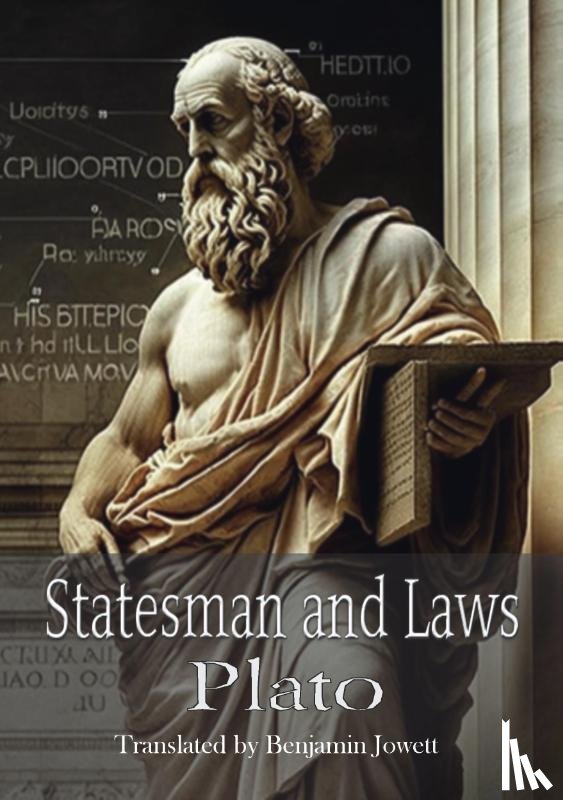
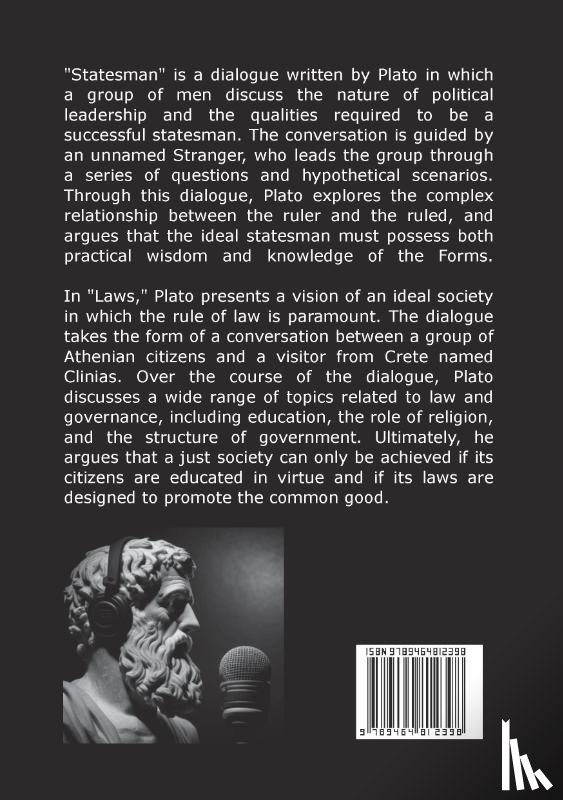
"Statesman" is a dialogue written by Plato in which a group of men discuss the nature of political leadership and the qualities required to be a successful statesman. The conversation is guided by an unnamed Stranger, who leads the group through a series of questions and hypothetical scenarios. Through this dialogue, Plato explores the complex relationship between the ruler and the ruled, and argues that the ideal statesman must possess both practical wisdom and knowledge of the Forms.
In "Laws," Plato presents a vision of an ideal society in which the rule of law is paramount. The dialogue takes the form of a conversation between a group of Athenian citizens and a visitor from Crete named Clinias. Over the course of the dialogue, Plato discusses a wide range of topics related to law and governance, including education, the role of religion, and the structure of government. Ultimately, he argues that a just society can only be achieved if its citizens are educated in virtue and if its laws are designed to promote the common good.
I have a question about the book:
‘Statesman and Laws - Plato’.
Fill in the form below.
We will respond as fast as possible.
We value your privacy
We use cookies to measure traffic, improve Boekstra and let Google tailor ads to your interests. You can keep using the site either way — even if you decline. More info