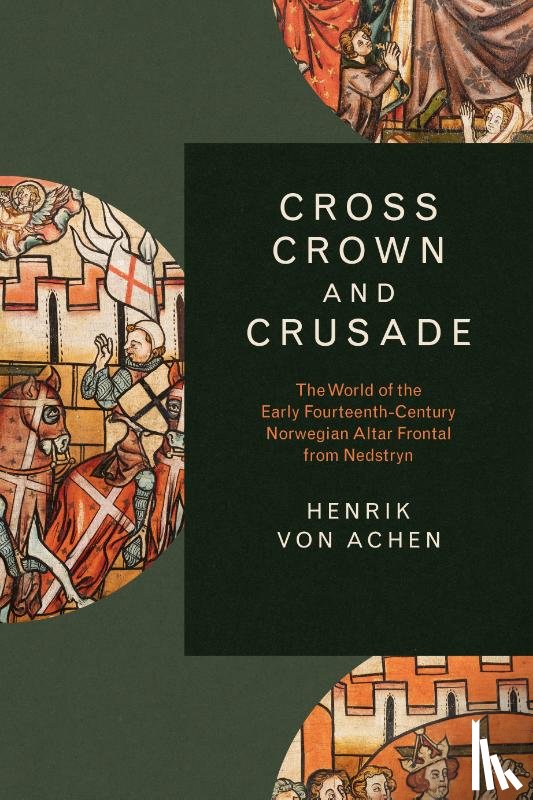
The World of the Early Fourteenth-Century Norwegian Altar Frontal from Nedstryn
Description
A multidisciplinary study of a unique Scandinavian altar frontal. The altar frontal from Nedstryn in Western Norway is the only preserved medieval panel painting in Europe that displays an extensive version of the legend of Heraclius and the True Cross. To understand the message conveyed by the painting, this study adopts a multidisciplinary approach that encompasses the art history of High Medieval altar decorations, discusses the primary agents – patron, adviser, and master – and considers the intended Norwegian audience, while tracing the visual and textual sources available around 1300.
Embedded in this seemingly straightforward narrative lies a wealth of meaning: the function of the Holy Cross, the concept of Christian kingship and the role of Crusades as waging both a military and spiritual battle against “enemies of the Cross”. The medieval audience was encouraged to follow the example of Heraclius and engage in this struggle.
Grounded in a contextual analysis of both meaning and production, the study mobilizes sources across regions and centuries, and shows how visual and textual literacies were shaped by secular and liturgical practices. It demonstrates how a work produced in Bergen around 1315 aligns with broader Northern European artistic and cultural developments.
Henrik von Achen is Professor Emeritus of Art History at the University of Bergen. The altar frontal from Nedstryn in Western Norway is the only preserved medieval panel painting in Europe that displays an extensive version of the legend of Heraclius and the True Cross. To understand the message conveyed by the painting, this study adopts a multidisciplinary approach that encompasses the art history of High Medieval altar frontal decorations, discusses the primary agents – patron, adviser, and master – and considers the intended Norwegian audience, while tracing the visual and textual sources available around 1300.
Embedded in this seemingly straightforward narrative lies a wealth of meaning: the function of the Holy Cross, the concept of Christian kingship and the role of Crusades as waging both a military and spiritual battle against “enemies of the Cross”. The audience was encouraged to follow the example of Heraclius and engage in this struggle.
Grounded in a contextual analysis of both meaning and production, the study mobilises sources across regions and centuries, and shows how visual and textual literacies were shaped by secular and liturgical practices. It demonstrates how a work produced in Bergen around 1315 aligns with broader Northern European artistic and cultural developments. Preface
Chapter 1. Introduction
1.1 The altar frontal from Nedstryn: A presentation
1.2 Intention of the study
1.3 Structure of the investigation
Chapter 2. The Medieval Altar Frontal
2.1 The altar frontal
2.2 Frontal or retable
2.3 Sets of panels decorating the altar
2.4 Antependia
2.5 European panel painting 1250–1350
Chapter 3. Method and Research: A Survey
3.1 The loss of medieval altar frontals
3.2 The problem of similarity: homogeneity and conventionality
3.3 The rationality of using images
3.4 Research on the altar frontal from Nedstryn: A survey
Chapter 4. The Production of the Altar Frontal from Nedstryn
4.1 Introductory remarks
4.2 Patron
4.3 Advisor
4.4 Master
4.5 Workshop
4.6 Art trade
Chapter 5. Sources of the Heraclius Narrative: Text, Tradition, and Tituli
5.1 Textual sources
5.2 Written versions of the Heraclius narrative in the North
5.3 Discrepancies
5.4 Tituli
Chapter 6. The Iconographic Tradition of the Heraclius Narrative
6.1 Introductory remarks
6.2 Illuminations
6.3 The Sienese panel
6.4 Enamelled plaques
6.5 The window in Sainte-Chapelle, Paris
6.6 Murals
Chapter 7. The Narrative: Context and Meaning
7.1 Introductory remarks
7.2 Exemplum
7.3 Compositional structure
7.4 The eschatological dimension
7.5 King
7.6 Courtly literature and pious bravery
7.7 Crusader
7.8 Christian
Chapter 8. The Liturgical Context of the Nedstryn Frontal
8.1 Introductory remarks
8.2 Liturgy
8.3 Liturgical literacy
8.4 Liturgical change
8.5 Presentation of the Cross
8.6 Palm Sunday and Good Friday
8.7 The Feast of the Exaltation of the Cross
Chapter 9. Provenance and Patron of the Nedstryn Frontal
9.1 The uncertainty of the provenance
9.2 The less-probable provenances
9.3 The church at Nedstryn in Nordfjord
9.4 A royal chapel: The Church of the Holy Cross in Fana
9.5 A royal chapel: The Church of the Apostles in Bergen
9.6 The patron of the altar frontal from Nedstryn
Chapter 10. Conclusion
10.1 The basic positions
10.2 The altar frontal from Nedstryn
10.3 Sources
10.4 Meaning
10.5 Summary
Tables
Table 1. Correspondence between scene, titulus, and image
Table 2. Scenes from the legend of Heraclius and the True Cross, depicted before 1362
Notes
Abbreviations
Bibliography
I have a question about the book:
'Cross, Crown and Crusade - von Achen, Henrik'.
Fill in the form below.
We will respond as fast as possible.
We value your privacy
We use cookies to measure traffic, improve Boekstra and let Google tailor ads to your interests. You can keep using the site either way — even if you decline. More info