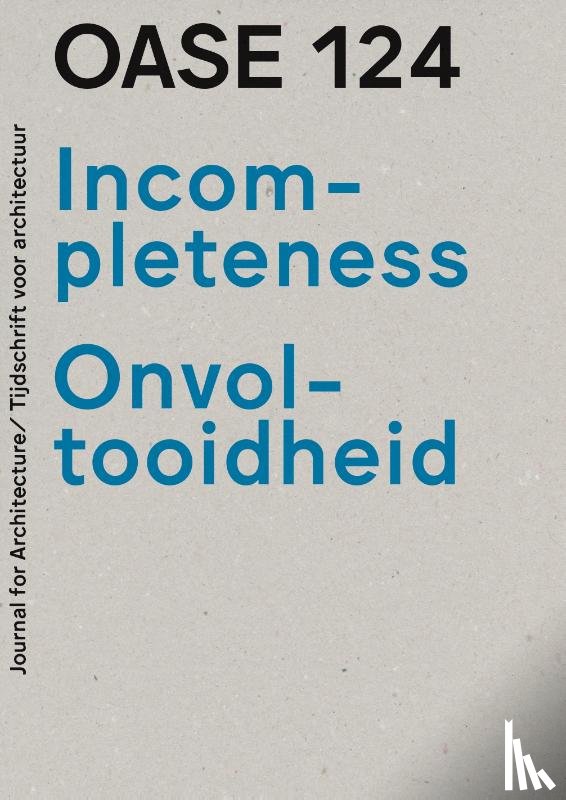
As Paul Valéry says, a work is never ‘finished’; it can only be abandoned and let go
Incompleteness as a design tool to give residents and users space
The incomplete project as a challenge to prevailing values and practices in architecture
Even after construction and completion, a building is never truly ‘finished’. Everyday use continually reveals the need for adaptation. What if we elevated this incompleteness of architecture to a design principle, thereby literally giving residents and users room to shape their environment?
The most recent, well-known and evocative example of deliberately unfinished architecture is Elemental’s design for the Quinta Monroy project in Iquique, Chile (2003), where the practice intentionally designed ‘half-good houses’, expecting residents to complete the other half themselves. Elemental’s project is not an isolated case, but part of a broader range of attempts to create consciously ‘unfinished’ architecture.
This issue of OASE documents a selection of these projects, each of which challenges established architectural practice in terms of its values, the position of the designer and the very definition of a project.
As Paul Valéry says, a work is never ‘finished’; it can only be abandoned and let go
Incompleteness as a design tool to give residents and users space
The incomplete project as a challenge to prevailing values and practices in architecture
Even after construction and completion, a building is not ‘finished’. Daily use consistently reveals that adjustments are needed. What if we elevate this incomplete nature of architecture to a design principle, thereby literally giving residents and users the space they need?
The most recent, well-known and evocative example of literally unfinished architecture is Elemental’s design for the Quinta Monroy project in Iquique, Chile (2003), where the firm deliberately designed ‘half-finished houses’ with the intention that residents would complete the other half. Elemental’s design does not stand alone but is part of various attempts to build a deliberately ‘unfinished’ architecture.
This issue of OASE documents a number of these projects, each of which challenges current established practice regarding its values, the designer’s position and the definition of a project.
I have a question about the book:
'OASE 124 - '.
Fill in the form below.
We will respond as fast as possible.
We value your privacy
We use cookies to measure traffic, improve Boekstra and let Google tailor ads to your interests. You can keep using the site either way — even if you decline. More info