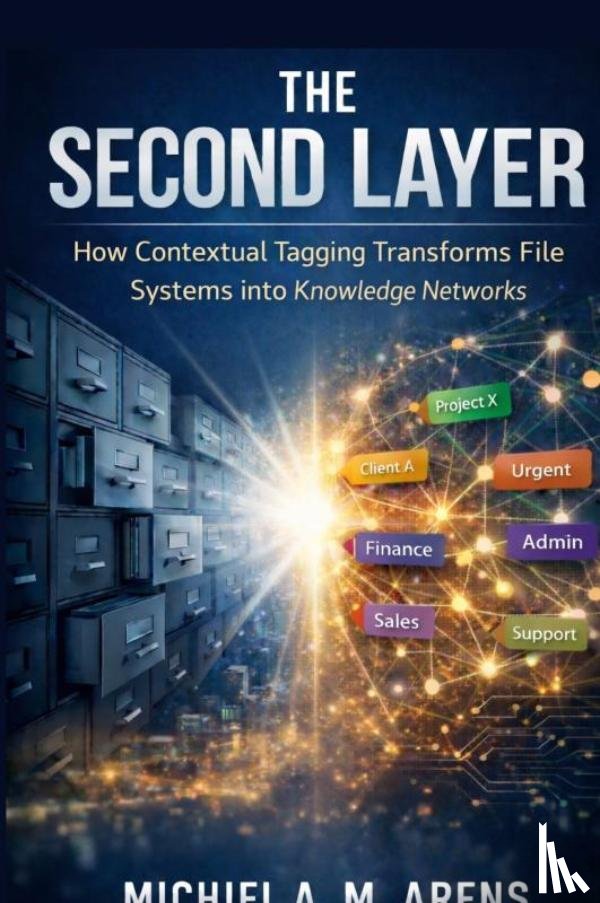
How Contextual Tagging Transforms File Systems into Knowledge Networks
Description
Why is finding a file still so difficult?
Despite powerful computers and advanced software, most professionals still organize digital information using hierarchical folders—an approach designed for a simpler, slower world. Today’s work is different. Projects overlap, teams collaborate across functions, and documents relate to multiple contexts at once.
The Second Layer explains why traditional folder systems create friction and introduces a powerful alternative: contextual tagging.
Instead of forcing every document into a single location, tagging adds a second layer of organization based on meaning. Files can be connected to projects, clients, timeframes, and themes simultaneously, transforming static folder structures into flexible knowledge networks.
Drawing on insights from cognitive science, information architecture, and real-world digital work, Michiel A. M. Arens shows how this approach reduces search time, lowers cognitive load, and improves visibility across complex work environments.
The Second Layer offers a new way to think about digital organization—one that aligns information systems with how modern professionals actually work.
I have a question about the book:
‘The Second Layer - Arens, Michiel’.
Fill in the form below.
We will respond as fast as possible.
We value your privacy
We use cookies to measure traffic, improve Boekstra and let Google tailor ads to your interests. You can keep using the site either way — even if you decline. More info