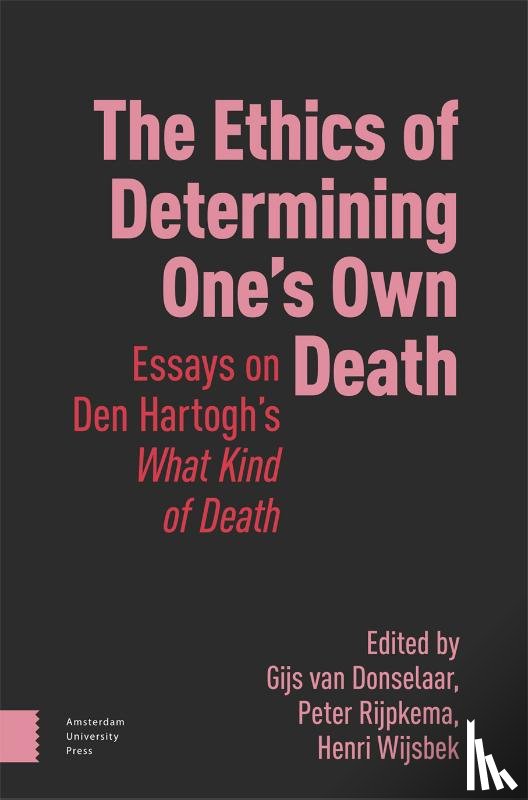
This collection brings together key contributions on the ethics of end-of-life decisions, inspired by the publication of What Kind of Death: The Ethics of Determining One’s Own Death, a new standard work by professor Govert den Hartogh. The topics covered reflect the book's comprehensive approach, with its central themes explored by ethicists, legal experts, and medical professionals. The various contributions offer a thorough examination of the major steps in Den Hartogh’s 'dual track approach'. This collection serves as a valuable supplement to the book and an important contribution to the ongoing debate about patient self-determination and well-being as foundational values in the ethics of determining one’s own death. 1. Preface
2. Self-Determination and its Limits
3. Whose Life is it anyway? Some reflection of Den Hartogh’s What Kind of Death
4. Dual or single gauge? Govert den Hartogh’s ‘dual-track’ assisted death
5. The changing (and multifaceted) role of the principle of self-determination in the Dutch euthanasia practice
6. Like a peat fire. The impact of the right to self-determination on the (Dutch) law of euthanasia
7. Work to be done: an inquiry concerning legal certainty in the fourth evaluation of the Dutch euthanasia act
8. Fear, incompetence and death. Empirical observations and ethical concerns about dying with advanced dementia.
9. Response to comments
I have a question about the book:
‘The Ethics of Determining One’s Own Death - ’.
Fill in the form below.
We will respond as fast as possible.
We value your privacy
We use cookies to measure traffic, improve Boekstra and let Google tailor ads to your interests. You can keep using the site either way — even if you decline. More info