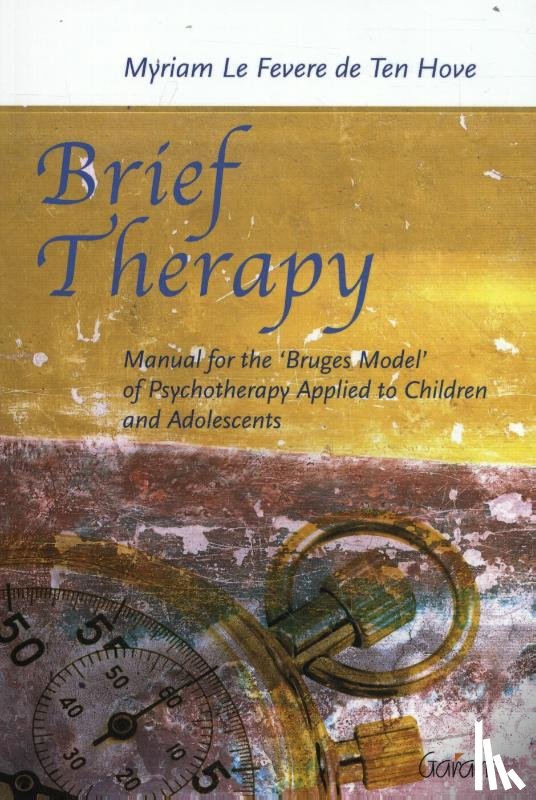
Manual for the ‘Bruges model’ of Psychotherapy Applied to Children and Adolescents
Description
The idea 'Brief Therapy' was introduced by the Palo Alto-school: John Weakland and Don Jackson and later on Paul watzlawick, Dick Fisch and Carlos Sluski. In this book, the Bruges Model of Brief Therapy is described. It was developed by the Korzybski-institute in Bruges (Belgium) with Luc Isebaert, Marie-Christine Cabié, Louis Cauffman and Myriam Le Fevere de Ten Hove. The participants of the 'Therapeutic Conversations 3'-congres in Denver (Colorado- USA) in 1996 gave it the name 'Bruges Model'. 'Brief' is not the purpose in itself, but the natural consequence of a respectful approach of the client, by which he again discovers the possibility of making a choice in his thinking and doing, in having his life under control, and so escaping the straitjacket of symptoms. Having the conviction that the client has the most know how in this matter, but often not realizes he has, as therapists we don't give ourselves the task of accompanying the client until the problem is completely solved. We stop when the client has found sufficiently his way to continue. This cooperative approach between the client and the therapist avoids creating resistance. The guideline of this model of Brief Therapy is applied to children and youngsters. Children are in a continuous evolution: this implicates varying opportunities and limitations. Youngsters are not very keen on therapy, especially not when their parents are asking for it. This book shows how to cope with these situations.
I have a question about the book:
'Brief Therapy - Le Fevere de Ten Hove, Myriam'.
Fill in the form below.
We will respond as fast as possible.
We value your privacy
We use cookies to measure traffic, improve Boekstra and let Google tailor ads to your interests. You can keep using the site either way — even if you decline. More info