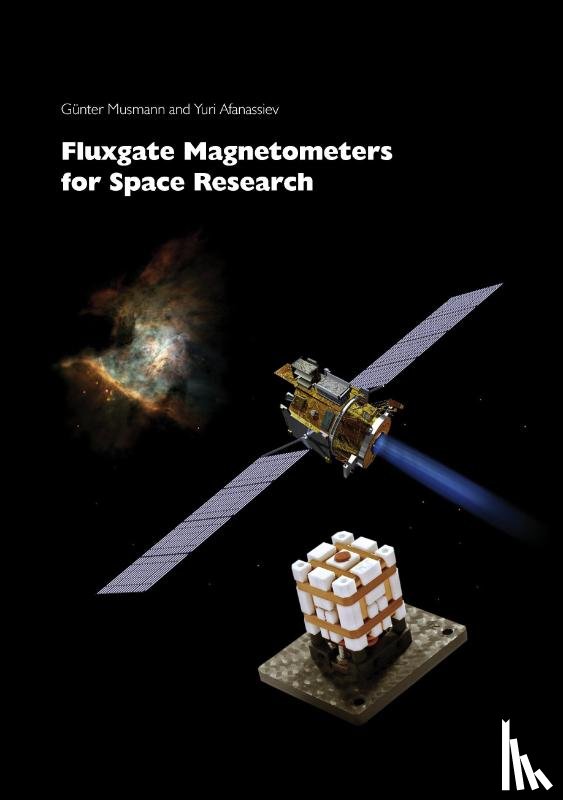
All fluxgate magnetometers are based on the theory of H.Aschenbrenner and G.Goubau developed in 1936 and the first fluxgates developed by F.Förster.Already the early satellites like putnik 3(Dolginov-Russia,1958),Mariner 4 (NASA/USA ,1964), the first German satellite AZUR (Musmann, 1969) studying the magnetic fields of the Earth,Moon,Venus,Mars and other planets were using fluxgate magnetometers up to the latest NASA/ESA investigations on CASSINI (1998),and ESA's Rosetta(2004) and the first Ion Engine spacecraft\,NASA-DEEP-SPACE-ONE(Musmann/Kuhnke,1998),(see cover.)
Very precise Earth magnetic field measurements in space have been made using fluxgate magnetometers in combination with scalar magnetometers (MAGSAT-Acuna,1979;OERSTED
-Primdahl,1999;CHAMP-Lühr,2000)
Only a few detailed descriptions about the theory and how to design and calibrate space fluxgate magnetometers and how to get reliable accurate magnetic field component measurements in space have been published.Therefore the worldwide small space fluxgate magnetometer community decided to document and save all their relevant know-how on space fluxgate magnetometers in this book before retirement.
I have a question about the book:
'Fluxgate Magnetometers for Space Research - '.
Fill in the form below.
We will respond as fast as possible.
We value your privacy
We use cookies to measure traffic, improve Boekstra and let Google tailor ads to your interests. You can keep using the site either way — even if you decline. More info