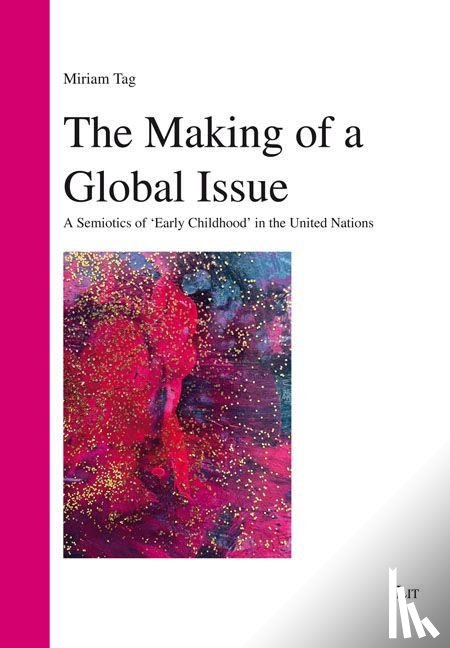
A Semiotics of 'Early Childhood' in the United Nations
Description
How do certain phenomena come to be recognised as global issues? And what enables a concept like 'early childhood'-once considered private and local-to be addressed alongside climate change, health, and human rights at the level of global governance?
This book explores how early childhood has been constituted as a global issue within the United Nations. Grounded in semiotic theory and informed by linguistic philosophy, it reconstructs the communicative processes and cultural logics-especially those of universalisation-that underpin its rise to global relevance.
With an original analytic approach and a focus on meaning-making in world culture, this study speaks to readers interested in global sociology, categorisation studies, cultural theory, and the politics of knowledge. It offers not only new insights into early childhood as a global issue, but also novel strategies for engaging empirically with processes of global institutionalisation.
Miriam Tag, Dr. phil. Sociology, MA philosophy, poet and artist, works at the intersection of literature, arts and environmental humanities, with a focus on deepening planetary relations, sensibilities and imaginations.
I have a question about the book:
'The Making of a Global Issue - Tag, Miriam'.
Fill in the form below.
We will respond as fast as possible.
We value your privacy
We use cookies to measure traffic, improve Boekstra and let Google tailor ads to your interests. You can keep using the site either way — even if you decline. More info