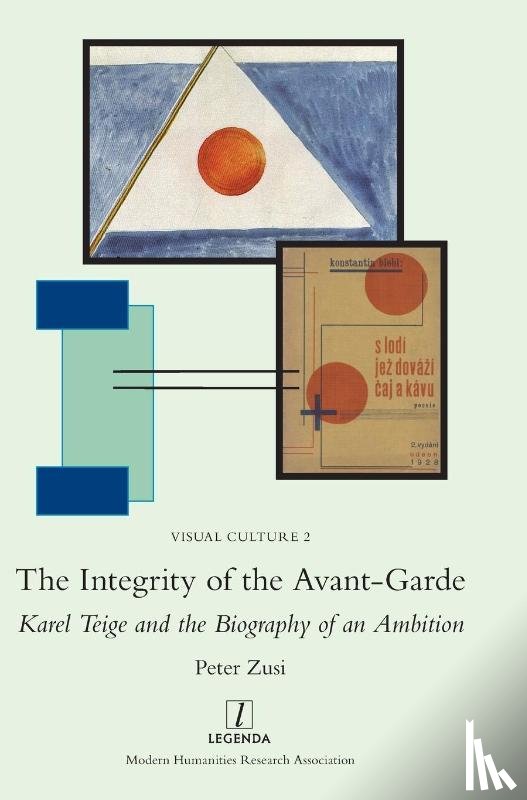
On what grounds do we speak of 'the avant-garde' in interwar European culture? Why do we understand the conflicts and quarrels among these diverse movements as expressing a shared attitude - the culture of the manifesto, the drive to reject, to explore, to renew - that trumps the conflicts and quarrels themselves? Why do the stern rationalism of a functionalist building and the irreverent irrationalism of a Dadaist performance seem heralds of a similar spirit?The Czech avant-garde theorist Karel Teige (1900-1951) regarded architecture and film as providing the key to formulating a unified theory that would capture this 'integrity of the avant-garde'. Teige - whose thought has many points of contact with celebrated figures such as Georg Lukács and Walter Benjamin, and who was a close associate of Le Corbusier, André Breton, and Hannes Meyer - reveals how a vibrant 'alternative' avant-garde tradition can raise central questions for understanding European modernism more broadly.Peter Zusi is Associate Professor of Czech and Comparative Literature at the School of Slavonic and East European Studies, University College London.
I have a question about the book:
‘The Integrity of the Avant-Garde - Zusi, Peter’.
Fill in the form below.
We will respond as fast as possible.
We value your privacy
We use cookies to measure traffic, improve Boekstra and let Google tailor ads to your interests. You can keep using the site either way — even if you decline. More info