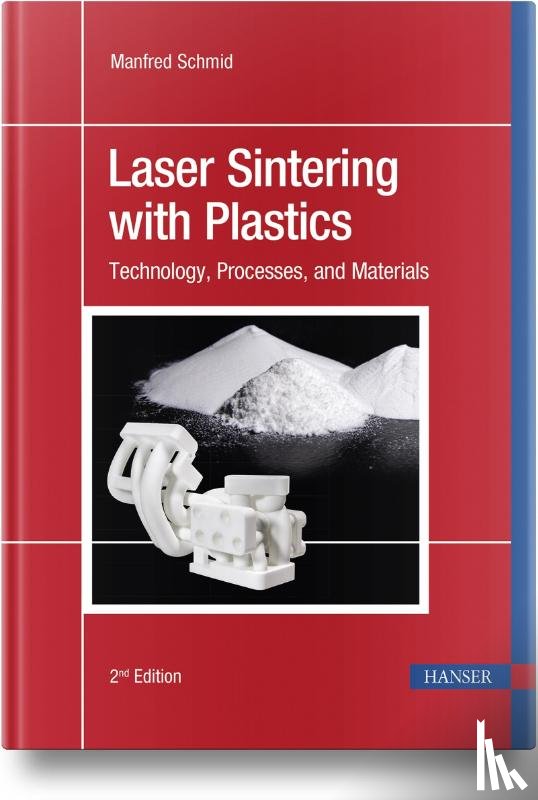
Powder bed-based additive manufacturing with polymers (PBF-P) has a special position in the world of 3D printing. On the one hand, the components are manufactured without support structures, and on the other hand, the property profile of the components is similar to that of series components, as is also known from injection molding, but with clear advantages in terms of component complexity.
In laser sintering (LS), individual component layers are fused with the aid of suitable laser radiation. In recent years, LS components have gained widespread use in industrial applications, so that today one can already speak of an established technology. Nevertheless, there are still many hurdles for LS to overcome in the future in order to free itself from the status of a niche technology. Material diversity and industry-compliant, quality-assurance measures are among the challenges to be mentioned here.
To this end, the second edition of this book sheds light on the current state of the art in terms of machine technology and process flow, and specifically on the requirements for the materials used. In addition, the following topics are presented:
- Implementation of LS in industrial process chains
- Status of international standardization
- Innovations in the field of LS materials
- Properties of LS components
- Selected application examples
The second edition has been updated throughout; in particular, the material and machine specifications have been extensively revised.
I have a question about the book:
'Laser Sintering with Plastics - Schmid, Manfred'.
Fill in the form below.
We will respond as fast as possible.
We value your privacy
We use cookies to measure traffic, improve Boekstra and let Google tailor ads to your interests. You can keep using the site either way — even if you decline. More info