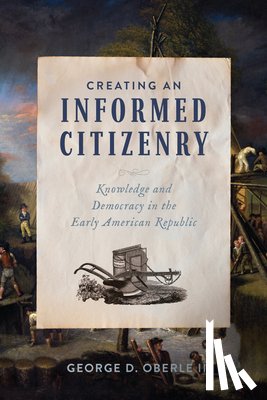
Knowledge and Democracy in the Early American Republic
Description
Examining the early debates in the United States over how best to educate the constituents of the new nation. When the founding fathers of the United States inaugurated a system of government that was unprecedented in the modern world, they knew that a functioning democracy required an educated electorate capable of making rational decisions. But who would validate the information that influenced citizens' opinions? By spotlighting various institutions of learning, George Oberle provides a comprehensive look at how knowledge was created, circulated, and consumed in the early American republic. Many of the founders, including George Washington, initially favored the creation of a centralized national university to educate Americans from all backgrounds. Over the first half of the nineteenth century, however, politicians moved away from any notion of publicly educated laypeople generating useful knowledge. The federal government ultimately founded the Smithsonian Institution in Washington, DC, to be run by experts only. Oberle's insightful analysis of the competing ideas over the nature of education offers food for thought as we continue to grapple with a rapidly evolving media landscape amid contested meanings of knowledge, expertise, and the obligations of citizenship.
I have a question about the book:
'Creating an Informed Citizenry - Oberle, George D.'.
Fill in the form below.
We will respond as fast as possible.
We value your privacy
We use cookies to measure traffic, improve Boekstra and let Google tailor ads to your interests. You can keep using the site either way — even if you decline. More info