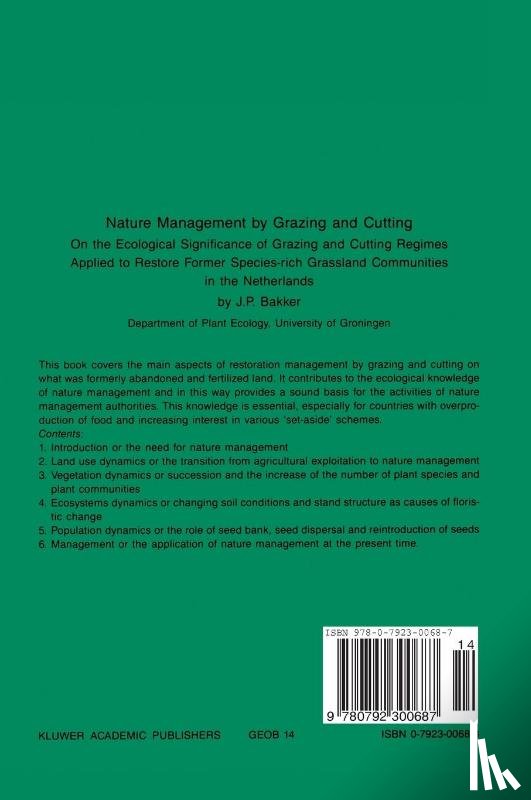
On the ecological significance of grazing and cutting regimes applied to restore former species-rich grassland communities in the Netherlands
Description
A. Background and scope of the study .............. . 3 1. General .................. " ,-, ........... 11 B. Abandoned and marginal agricultural grasslands ... . 5 2. Some equilibrium models explaining species di- 1. Definition ............................... . 5 versity ., ....... , ,-.... , .................. 11 2. Inland areas in western Europe ............. . 6 3. Change of the steady state .. , .. , ............ 14 3. Ca. stal areas in western Europe ............ . 8 4. Dispersal of plant species ................ , ,- 14 C. Nature mc.nagement practices ................... . 10 5. 'Ecotypic' diversity .. , ..................... 15 D. Theoretical considerations on nature management 6. Patterns in plant communities ............... 15 with special reference to diversity ............... . 7. ............. ,. 11 Implications for management 16 LA. Background and scope of the study (Klapp, 1965), Belgium (Van Hecke, Impens & Behaeghe, 1981) and the Netherlands (Oomes & The degradation of flora and vegetation in natural Mooi, 1981; Elberse, Van Den Bergh & Dirven, and semi-natural landscapes has become a matter 1983; Willems, 1983A).
I have a question about the book:
‘Nature Management by Grazing and Cutting - ’.
Fill in the form below.
We will respond as fast as possible.
We value your privacy
We use cookies to measure traffic, improve Boekstra and let Google tailor ads to your interests. You can keep using the site either way — even if you decline. More info