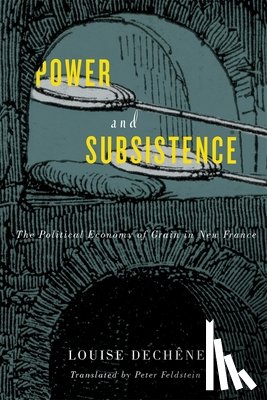
Subsistence crops – the grains and other food items necessary to a people's survival – were a central preoccupation of the early modern state. In New France, the principal crop in question was wheat, and its production, consumption, exchange, and regulation were matters to which the government devoted sustained attention. Power and Subsistence examines the official measures taken to regulate the grain economy in New France, the frequency and nature of state interventions in the system, and the responses these actions provoked. Drawing on social and political perspectives and methodologies, this book brings rural and agricultural history into conversation with colonial political economy. Louise Dechêne shows that unlike in early eighteenth-century France, where the marketplace dominated and trade was transparent, the grain economy in New France was hypercentralized and government measures were increasingly harsh. Attentive to the conflicts arising between producers, merchants, consumers, and colonial administrators over the allocation of the harvest, Dechêne offers a revealing perspective on the operation of political power in a colonial setting. Lively, elegant, and wry, Power and Subsistence provides insight into the last era of French rule in North America – and, in part, how that era came to an end. A lively exploration of the nature of power in New France, as enacted within the grain economy.
I have a question about the book:
'Power and Subsistence - Dechene, Louise'.
Fill in the form below.
We will respond as fast as possible.
We value your privacy
We use cookies to measure traffic, improve Boekstra and let Google tailor ads to your interests. You can keep using the site either way — even if you decline. More info