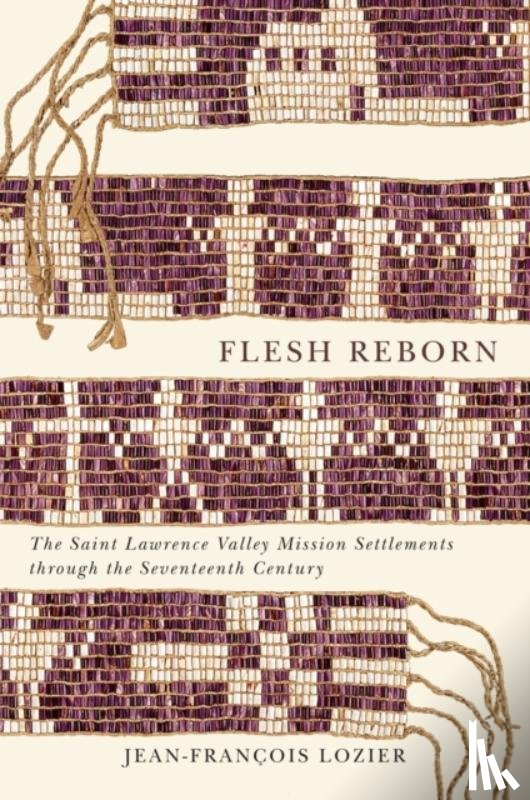
The Saint Lawrence Valley Mission Settlements through the Seventeenth Century
Description
The Saint Lawrence valley, connecting the Great Lakes to the Atlantic, was a crucible of community in the seventeenth century. While the details of how this region emerged as the heartland of French colonial society have been thoroughly outlined by historians, much remains unknown or misunderstood about how it also witnessed the formation of a string of distinct Indigenous communities, several of which persist to this day. Drawing on a range of ethnohistorical sources, Flesh Reborn reconstructs the early history of seventeenth-century mission settlements and of their Algonquin, Innu, Wendat, Iroquois, and Wabanaki founders. Far from straightforward byproducts of colonialist ambitions, these communities arose out of an entanglement of armed conflict, diplomacy, migration, subsistence patterns, religion, kinship, leadership, community-building, and identity formation. The violence and trauma of war, even as it tore populations apart and from their ancestral lands, brought together a great human diversity. By foregrounding Indigenous mission settlements of the Saint Lawrence valley, Flesh Reborn challenges conventional histories of New France and early Canada. It is a comprehensive examination of the foundation of these communities and reveals the fundamental ways they, in turn, shaped the course of war and peace in the region.
I have a question about the book:
'Flesh Reborn - Lozier, Jean-Francois'.
Fill in the form below.
We will respond as fast as possible.
We value your privacy
We use cookies to measure traffic, improve Boekstra and let Google tailor ads to your interests. You can keep using the site either way — even if you decline. More info