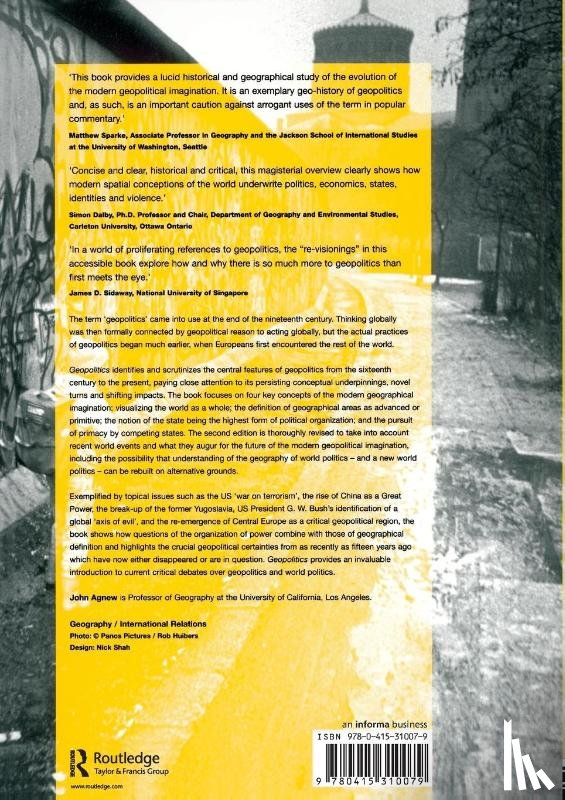
Despite challenges to its domination, the way modern-world politics is conducted is structured by a set of understandings dating back to the rise of the European powers. Here, John Agnew systematically explores how Europeans in a position of global power imposed their ways and views on others through visualizing the world as a whole, defining world regions as modern or backward, seeing the nation statehood as the highest and best form of political organization, and viewing world politics as the outcome of the pursuit of primacy by competing states.Exploring the elements of geographical imagination and how they have come together in different historical and modern epochs, this updated new edition examines:the implications of recent world events such as September 11thcontinued expansion of the EU and NATOthe near bankruptcy and failure of various statesthe re-ignition of the Israeli-Palestine conflict. Providing a lucid analysis of how world politics has come to be practised in its present form, Agnew identifies and argues for an alternative, given the costs visited on the world in twentieth century by the practice of the modern geographical imagination. Identifying and scrutinizing the central features of geopolitics from the sixteenth century to the present, author Agnew pays close attention to its persisting conceptual underpinnings, novel turns and shifting impacts.
I have a question about the book:
'Geopolitics - Agnew, John'.
Fill in the form below.
We will respond as fast as possible.
We value your privacy
We use cookies to measure traffic, improve Boekstra and let Google tailor ads to your interests. You can keep using the site either way — even if you decline. More info