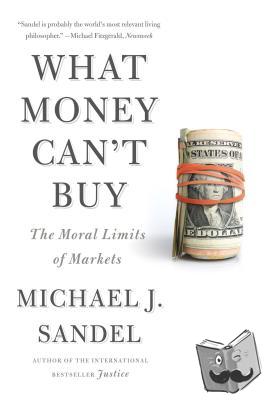
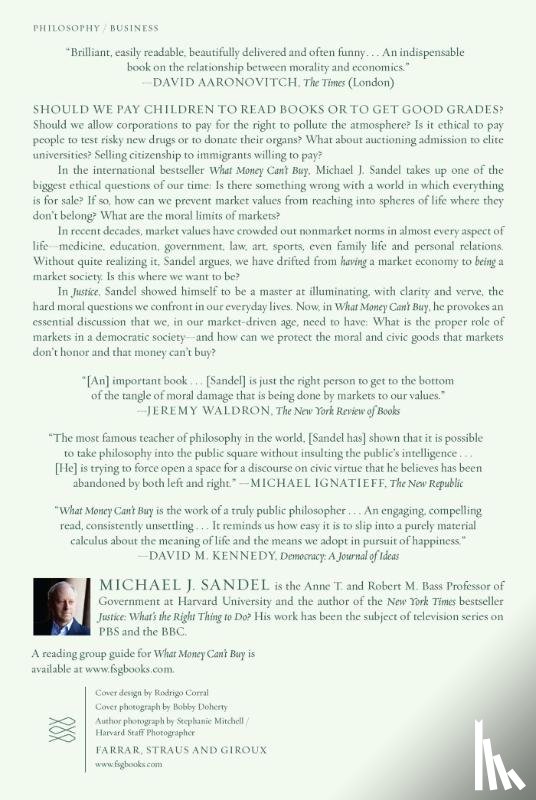
In What Money Can't Buy, renowned political philosopher Michael J. Sandel rethinks the role that markets and money should play in our society.Should we pay children to read books or to get good grades? Should we put a price on human life to decide how much pollution to allow? Is it ethical to pay people to test risky new drugs or to donate their organs? What about hiring mercenaries to fight our wars, outsourcing inmates to for-profit prisons, auctioning admission to elite universities, or selling citizenship to immigrants willing to pay? In his New York Times bestseller What Money Can't Buy, Michael J. Sandel takes up one of the biggest ethical questions of our time: Isn't there something wrong with a world in which everything is for sale? If so, how can we prevent market values from reaching into spheres of life where they don't belong? What are the moral limits of markets? Over recent decades, market values have crowded out nonmarket norms in almost every aspect of life. Without quite realizing it, Sandel argues, we have drifted from having a market economy to being a market society. In Justice, an international bestseller, Sandel showed himself to be a master at illuminating, with clarity and verve, the hard moral questions we confront in our everyday lives. Now, in What Money Can't Buy, he provokes a debate that's been missing in our market-driven age: What is the proper role of markets in a democratic society, and how can we protect the moral and civic goods that markets do not honor and money cannot buy?
I have a question about the book:
‘What Money Can't Buy - Sandel, Michael J.’.
Fill in the form below.
We will respond as fast as possible.
We value your privacy
We use cookies to measure traffic, improve Boekstra and let Google tailor ads to your interests. You can keep using the site either way — even if you decline. More info