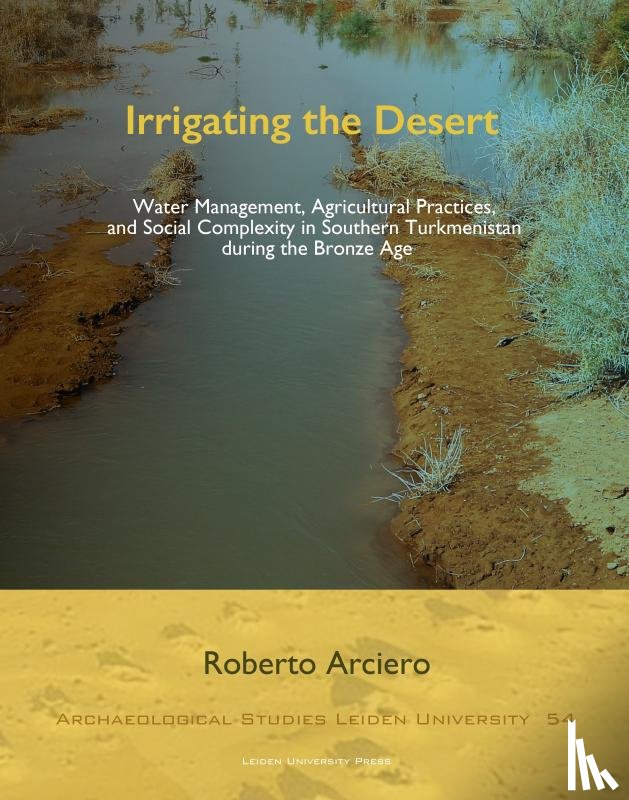
Water Management, Agricultural Practices, and Social Complexity in Southern Turkmenistan during the Bronze Age
Description
'Irrigating the Desert' explores how local communities adapted to environmental and hydrological changes in the Murghab alluvial fan. Ancient civilizations often developed near major rivers, like in Egypt and Mesopotamia. In Central Asia, the Murghab alluvial fan in southern Turkmenistan was central to the emergence of the Bactria-Margiana Archaeological Complex (BMAC), also known as the Oxus Civilization, during the third and second millennia BCE. The local alluvial fan was central for the productive agriculture at the basis of the region's urban centers and the wealth that accumulated in these societies.
This volume explores how local communities adapted to environmental and hydrological changes in the Murghab alluvial fan. Using remote sensing analysis and archaeological and geoarchaeological approaches to ancient water systems, the study demonstrates how these communities responded to climatic oscillations and more short term fluctuations in water availability, and how water resources were utilized in diverse agricultural strategies. It investigates how settlement patterns, agricultural techniques, and water management practices were interrelated. The transformations that occurred during this period were especially significant, paving the way for a system of Central Asian oases that became integral to the well-known Silk Road network. Ancient civilizations often developed near major rivers, like in Egypt and Mesopotamia. In Central Asia, the Murghab alluvial fan in southern Turkmenistan was central to the emergence of the Bactria-Margiana Archaeological Complex (BMAC), also known as the Oxus Civilization, during the third and second millennia BCE. The local alluvial fan was central for the productive agriculture at the basis of the region's urban centers and the wealth that accumulated in these societies.
This volume explores how local communities adapted to environmental and hydrological changes in the Murghab alluvial fan. Using remote sensing analysis and archaeological and geoarchaeological approaches to ancient water systems, the study demonstrates how these communities responded to climatic oscillations and more short term fluctuations in water availability, and how water resources were utilized in diverse agricultural strategies. It investigates how settlement patterns, agricultural techniques, and water management practices were interrelated. The transformations that occurred during this period were especially significant, paving the way for a system of Central Asian oases that became integral to the well-known Silk Road network. Table of Contents; List of Figures; List of Tables; Chapter 1 – Introduction; Chapter 2 – The Geology and Climate of Southern Turkmenistan; Chapter 3 – The Archaeological Context and Theoretical Framework; Chapter 4 – Methodology; Chapter 5 – Results from the Ojakly Area; Chapter 6 – Results from the Togolok Area; Chapter 7 – Discussion and Conclusion; Acknowledgments; References; Appendices; Glossary