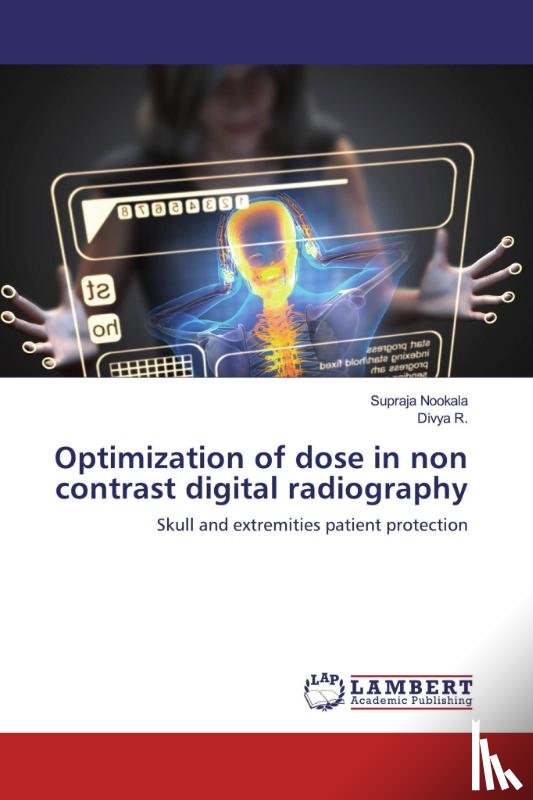
Optimization of dose in non contrast digital radiography
Skull and extremities patient protection
Description
Radiography is an imaging technique using X-rays, gamma rays, or similar ionizing radiation and non-ionizing radiation[1] to view the internal form of an object. Applications of radiography include medical radiography ("diagnostic" and "therapeutic") and industrial radiography. Similar techniques are used in airport security (where "body scanners" generally use backscatter X-ray). To create an image in Conventional Radiography, a beam of X-rays is produced by an X-ray generator and is projected toward the object. A certain amount of the X-rays or other radiation is absorbed by the object, dependent on the object's density and structural composition. The X-rays that pass through the object are captured behind the object by a detector (either photographic film or a digital detector). The generation of flat two dimensional images by this technique is called projectional radiography. In computed tomography (CT scanning) an X-ray source and its associated detectors rotate around the subject which itself moves through the conical X-ray beam produced. Any given point within the subject is crossed from many directions by many different beams at different times
I have a question about the book:
‘Optimization of dose in non contrast digital radiography - Nookala, Supraja, R, Divya’.
Fill in the form below.
We will respond as fast as possible.