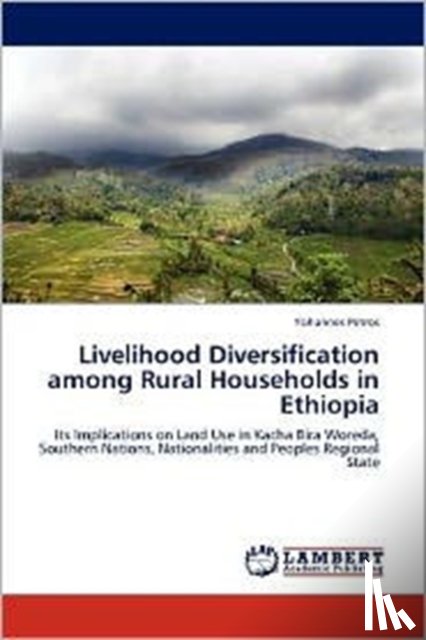
Livelihood Diversification among Rural Households in Ethiopia
Its Implications on Land Use in Kacha Bira Woreda, Southern Nations, Nationalities and Peoples Regional State
Description
The purpose of this study was to investigate the implications of livelihood diversification on land use patterns. The study combined both qualitative and quantitative techniques. The empirical results showed that because of declining farm size and fertility status, the majority of households engaged in on-farm, off-farm, non-farm and remittance means of livelihood. The study result also revealed that there is an increasing trend of allotting more size of farm land for cash crops in midland areas than in highland areas, where more size of land is allotted for annual crops. The rapid increase of population pressure on limited land resources has caused not only the scarcity of farm land but also expansion into fragile lands and steeper slopes previously considered marginal for crop production. The physical soil conservation infrastructures already in place are not in harmony with the resource availability and current resource use in mixed farming systems under critical land shortage conditions, hence, adequate emphasis should be given to environmentally friendly and economically viable off-farm and non-farm income generating strategies to attain sustainable land resources management.
I have a question about the book:
'Livelihood Diversification among Rural Households in Ethiopia - Petros, Yohannes'.
Fill in the form below.
We will respond as fast as possible.
We value your privacy
We use cookies to measure traffic, improve Boekstra and let Google tailor ads to your interests. You can keep using the site either way — even if you decline. More info