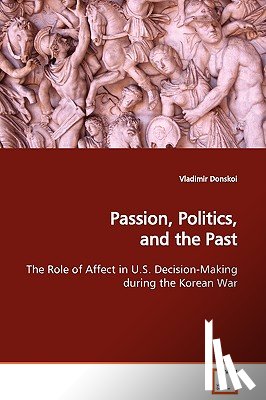
Passion, Politics, and the Past The Role of Affect in U.S. Decision-Making during the Korean War
The Role of Affect in U.S. Decision-Making during theKorean War
Description
This book shows that foreign policy decision-making
is not as "cool-minded" as it is deemed to be. It
analyses how the lessons of history influence
decision-making and argues that, during crises, a
decision-maker's affect (anger and fear) can bias him
towards straightforward responses of the fight or
flight type. This insight also prompts a fresh answer
to the question what analogies are likely to be
picked from the vast pool of historical events: a)
behaviourally straightforward analogies, with
forceful imagery and clear-cut affective
connotations; b) analogies that are already
established in the political discourse; c)
exceedingly grave analogies; d) many different
analogies with congruent inferences. Thus,
politicians tend to draw analogies that are
affectively salient (e.g. between Saddam Hussein and
Hitler) rather than factually accurate, and this
explains why such analogies are often farfetched. The
case on which the model is then tested is the U.S.
decision-making during 1st week of the Korean War.
This book will be especially interesting for scholars
and practitioners in the field of politics as well as
for everyone who wants to understand how emotions
influence decisions.
I have a question about the book:
‘Passion, Politics, and the Past The Role of Affect in U.S. Decision-Making during the Korean War - Donskoi, Vladimir’.
Fill in the form below.
We will respond as fast as possible.