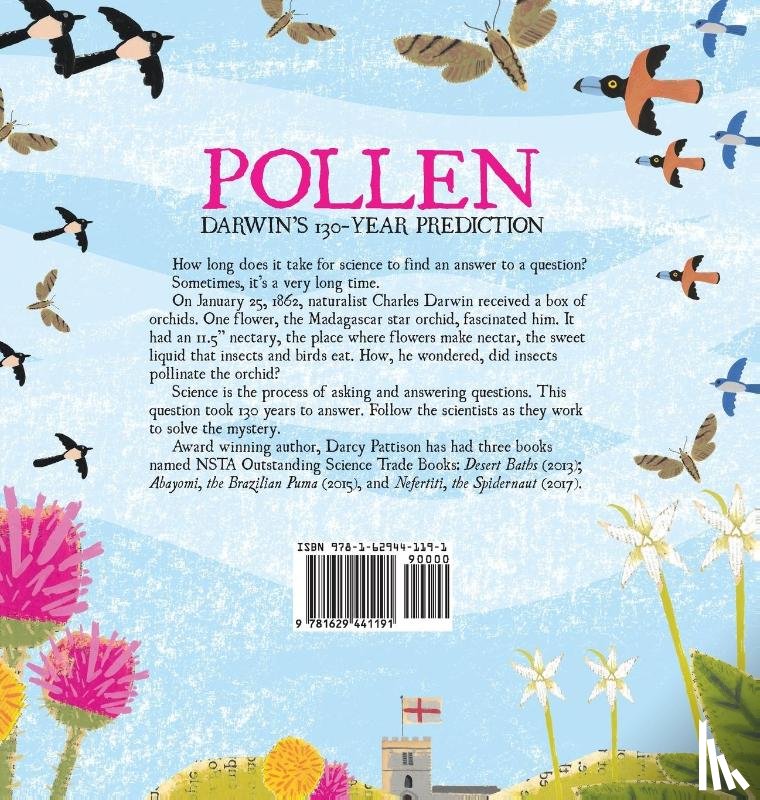
POLLEN: DARWIN'S 130 YEAR PREDICTION
Elementary Science - POLLEN
How long does it take for science to find an answer to a problem?
On January 25, 1862, naturalist Charles Darwin received a box of orchids. One flower, the Madagascar star orchid, fascinated him. It had an 11.5" nectary, the place where flowers make nectar, the sweet liquid that insects and birds eat. How, he wondered, did insects pollinate the orchid? It took 130 years to find the answer.
After experiments, he made a prediction. There must be a giant moth with a 11.5" proboscis, a straw-like tongue. Darwin died without ever seeing the moth, which was catalogued by entomologists in in 1903. But still no one had actually observed the moth pollinating the orchid.
In 1992, German entomologist, Lutz Thilo Wasserthal, Ph.D. traveled to Madagascar. By then, the moths were rare. He managed to capture two moths and released them in a cage with the orchid. He captured the first photo of the moth pollinating the flower, as Darwin had predicted 130 years before.
Backmatter includes information on the moth, the orchid, Charles Darwin, Lutz Wasserthal. Also included is Wasserthal's original photo taken in 1992.
MOMENTS IN SCIENCE COLLECTION
This exciting series focuses on small moments in science that made a difference.
BURN: Michael Faraday's Candle
CLANG! Ernst Chladni's Sound Experiments (2019 NSTA Outstanding Science Trade Book)
ECLIPSE: How the 1919 Eclipse Proved Einstein's Theory of General Relativity (Fall, 2019)
I have a question about the book:
'Pollen - Pattison, Darcy'.
Fill in the form below.
We will respond as fast as possible.
We value your privacy
We use cookies to measure traffic, improve Boekstra and let Google tailor ads to your interests. You can keep using the site either way — even if you decline. More info